- Flooring
What to Do in the First 24 Hours After a Flooded Floor in Calgary
March 20, 2026
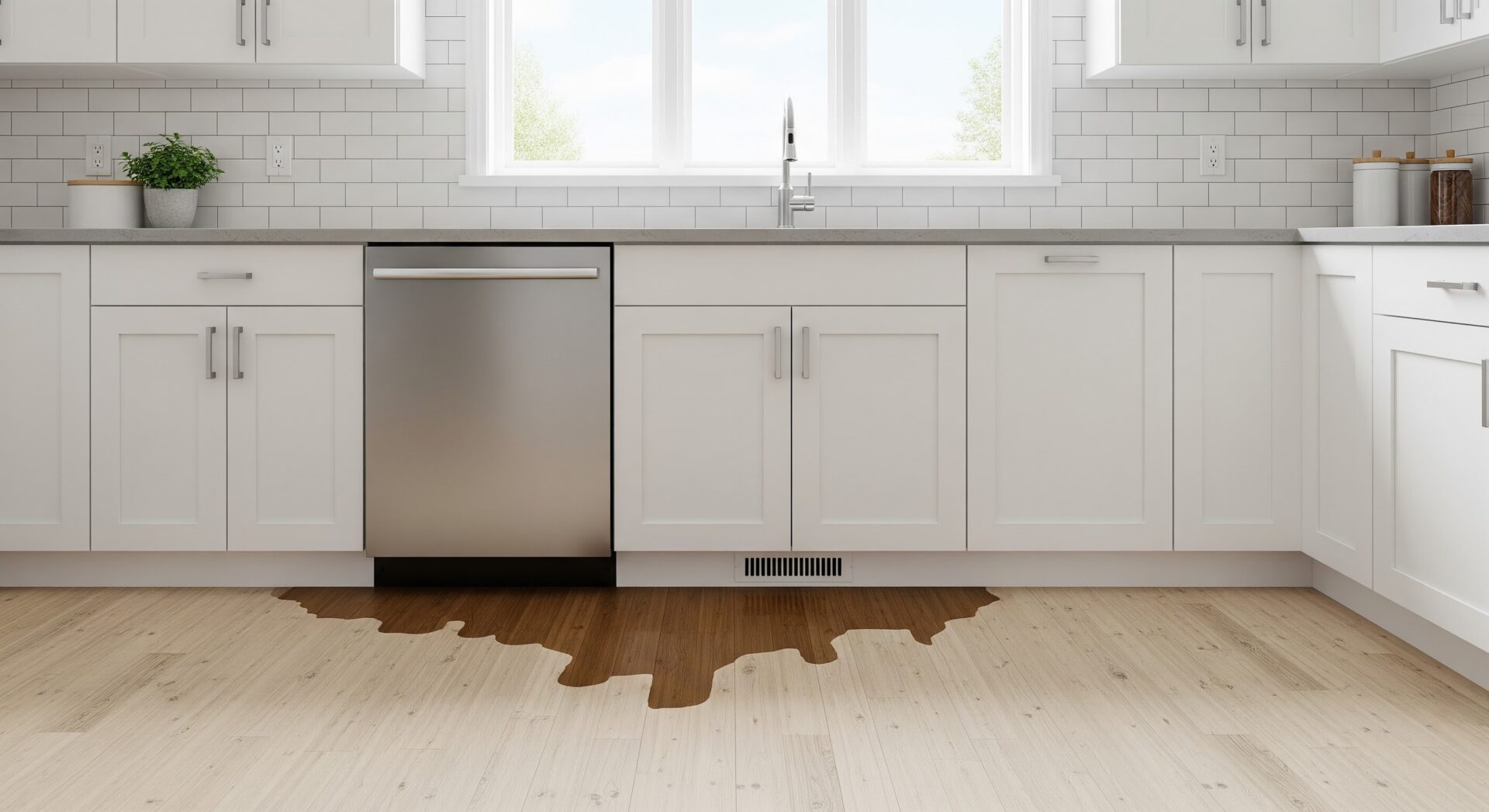
The five most critical steps are: cut power to the affected area, stop the water source, document everything before touching it, call your insurer, and get IICRC-certified water extraction started. All five need to happen within the first two hours. Everything else follows from those actions.
Calgary sits on top of one of the most flood-prone geological formations in western Canada. The Bow and Elbow river systems flow through a highly permeable alluvial aquifer of gravel and sand. When water levels rise, the water table rises with them, right up through your basement floor drain, even if your street never floods at all. University of Calgary researchers confirmed this after the devastating 2013 floods: in communities like Elbow Park and Roxboro, 88 per cent of homes that flooded did so from groundwater rising through the earth beneath them, not from the river overflowing above ground.
Of course, not every Calgary flood comes from the ground up. Burst pipes, failed hot water tanks, and appliance line failures are equally common. The same 24-hour principles apply regardless of where your water came from.
Water damage to your floors can arrive faster and more quietly than most Calgary homeowners expect. What you do in the first 24 hours determines whether you replace one damaged section or an entire floor.
If your floor just flooded, call us now at (403) 296-0985 or visit our showroom at 525 58 Avenue SE. We handle restoration flooring projects from start to finish, and the earlier you reach us, the more we can save.
If You’re Reading This Right Now:
- Cut power to the affected area before stepping into standing water
- Stop the water source if you safely can (main shutoff, appliance valve)
- Photograph everything before touching or moving anything
- Call your insurance company to open a claim immediately
- Call an IICRC-certified water extraction service — every hour matters
- 📞 Call Floorscapes now: (403) 296-0985
The full step-by-step guide is below. Come back to it once these six steps are done.
Jump to a section:
Why Water Damage Hits Calgary Floors Harder: Soil, Groundwater, and Climate
Most water damage articles are written for a generic North American audience. Calgary’s conditions are specific enough that generic advice can lead homeowners to make the wrong call entirely.
The groundwater problem. Calgary’s subsurface is composed of alluvial gravel and sand deposited by the Bow and Elbow rivers over thousands of years. This material is highly permeable, meaning water moves through it the way coffee moves through a paper filter: quickly and completely. When river levels rise after heavy rain or rapid snowmelt from the Rockies, the underground water table rises in step, sometimes faster than surface water. This is why homes in southeast and southwest Calgary communities sometimes flood from the floor drain up, with no visible source of water entry at the walls.
Freeze-thaw and ice damming. Calgary’s climate swings dramatically, often within 24 hours. Chinook winds can raise temperatures by 20°C or more in a matter of hours, rapidly melting roof snow that has nowhere to drain. Ice damming, where a ridge of ice blocks water at the roof edge, sends meltwater back into the structure and down through walls and subfloors. At Floorscapes, we see ice dam-related floor damage every spring, particularly in older SE Calgary homes and infill builds in communities like Ramsay and Inglewood where attic insulation has not been updated.
Humidity swings. Calgary averages around 48% relative humidity annually, but that number masks extreme seasonal variation. Winters can drop indoor humidity below 30% as heating systems run continuously, causing wood floors to contract and develop gaps. Then June arrives, Calgary’s wettest month with an average of nearly 14 rainy days, and humidity climbs back toward the 60s. That repeated expansion and contraction weakens adhesive bonds and creates micro-gaps where water infiltrates faster when a flood does occur.
Calgary sits in Hailstorm Alley. Severe summer storms, including the August 2024 hailstorm that caused over $3.25 billion in damage, can overwhelm eavestroughs and send water pouring against foundations faster than any drainage system can handle.
Pro-Tip — Floorscapes Flooring Team: In communities with homes built directly on slab-on-grade foundations, particularly in SE Calgary neighborhoods built in the 1970s and 1980s, we consistently read subfloor moisture levels that are elevated even before any visible flood event. Before we install any wood-based product in these homes, we always run a full moisture barrier and vapor assessment. If you skipped that step during your last renovation and your floor just flooded, assume your concrete is already holding moisture and act accordingly.
Water Damage Floor Calgary: Your 24-Hour Emergency Action Plan
Hour 0–2: Stop the Water and Make It Safe
The first priority is not saving your floor. It is making your home safe to be in.
Cut the power. Before you walk through standing water, turn off the electrical breakers to the affected area. Standing water and live circuits are a lethal combination. If your electrical panel is in the flooded area, call your utility company or an electrician before entering.
Stop the source if you can. Burst pipe? Shut off the main water supply. Appliance failure (dishwasher, washing machine, hot water tank)? Shut off the supply valve behind the unit. Sewer backup or groundwater entry? You cannot stop the source, but you can call emergency water extraction services immediately.
Document everything before touching it. Take photos and video of every affected area before you start cleanup. Walk the perimeter and capture the water line, affected flooring, walls, and any furniture. Your insurance adjuster will need this, and it will help flooring restoration professionals assess the scope of damage accurately.
Call your insurance company. Most Calgary home insurance policies include overland flood coverage and water damage provisions, though sewer backup coverage is often a separate add-on. Report the claim immediately, as insurers often require prompt notification. If you are working through an insurance rebuild, we have extensive experience coordinating flooring restoration through insurance claims and can work directly with your adjuster.
Hour 2–6: Extract the Water
This is the most time-critical phase for your floors. Every hour that standing water sits on your surface and soaks into your subfloor compounds the damage.
For small floods from appliances or minor pipe bursts: A wet/dry shop vacuum can extract standing water from hard surfaces quickly. Mop up the remainder and get fans running immediately. Before opening windows, check the outdoor humidity: if it is above 60%, keep windows closed and run dehumidifiers exclusively. In a summer storm that just flooded your basement, outdoor air is almost certainly too humid to help. If outdoor humidity is below 50%, opening windows will assist drying.
For significant flooding from sewer backup, groundwater, or major pipe failure: Call an IICRC-certified restoration company for emergency water extraction. These companies use industrial truck-mounted extraction systems that pull water out of subfloors and concrete that a shop vac cannot reach. Certified technicians follow established drying protocols that are often required by insurance companies.
The mold clock starts sooner than you think. In warm Calgary summer conditions, a basement above 18°C with organic materials like OSB and wood framing still wet can see mold colony formation begin in as little as 12 to 24 hours. Do not wait until morning to make calls.
Mold under your subfloor is not just a flooring problem. It is a structural and health problem that significantly increases remediation costs.
“We had to replace our hardwood and tile after a home flood. Bryce was so helpful with getting us the right flooring — within our insurance budget — and was able to source whatever we were looking for when we wanted to change it up! The installation was excellent, with a very high level of workmanship. We highly recommend them.” — BestProsInTown Reviewer, Calgary — Hardwood and Tile Restoration
Hour 6–12: Assess Your Floors Honestly
Once the standing water is removed, you need to assess what you are actually dealing with. This assessment drives every decision that follows, including what to tell your insurance company.
Critical: Know Your Water Type Before Assessing Salvageability
The IICRC S500 standard classifies flood water into three categories. Category 1 is clean water from a supply line or appliance. Category 2 is grey water from appliance overflow or dishwasher discharge. Category 3 (also called black water) includes sewage backup, toilet overflow, and groundwater entry from outside.
This matters enormously in Calgary, where the most common flood source is groundwater rising through the water table. Groundwater is Category 3 water, regardless of how clear it looks. Wood flooring and wood-based subfloor materials (OSB, plywood) exposed to Category 3 water cannot be dried and saved. They must be removed and replaced. If your flood came up through a floor drain, treat all wood materials in the affected area as non-salvageable from the outset.
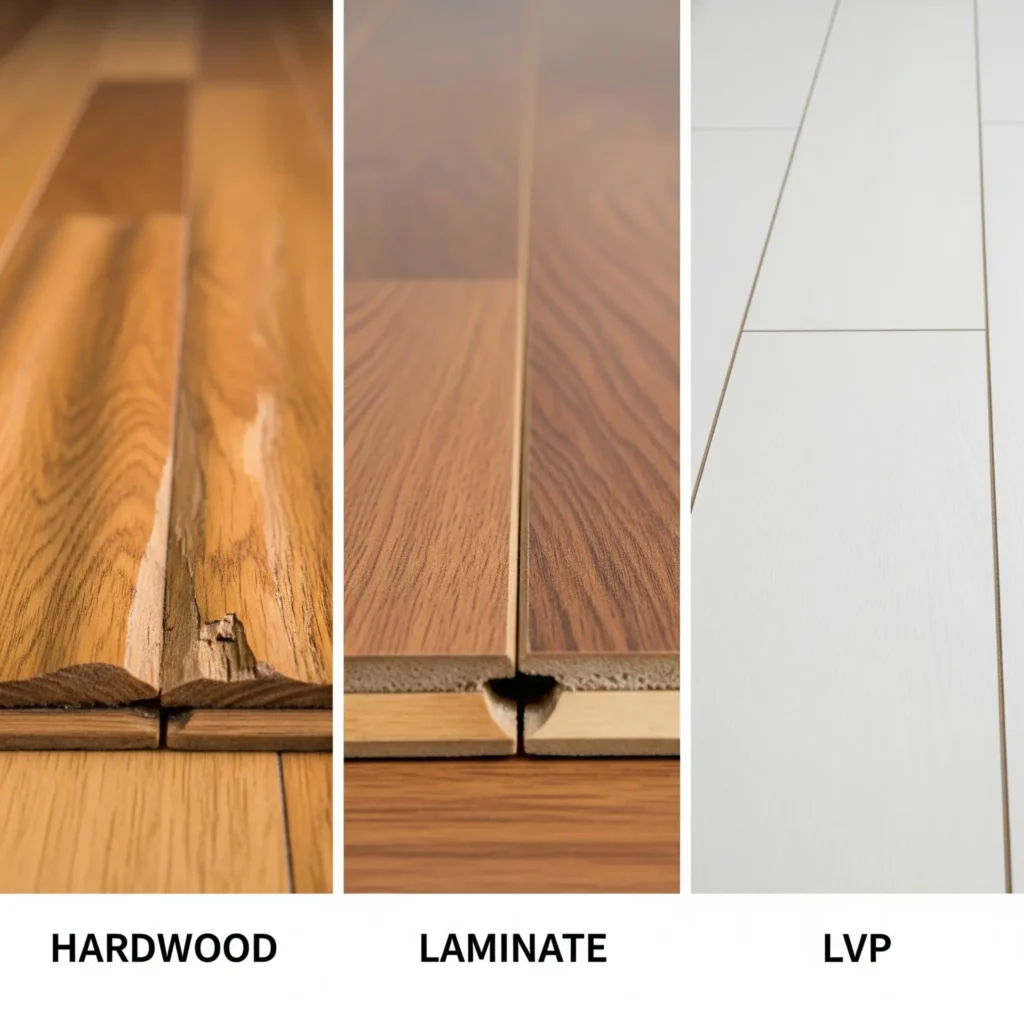
Hardwood floors. Solid hardwood is the most vulnerable floor type to water damage. It absorbs moisture rapidly and begins to cup within hours of exposure — cupping is where the edges of each plank rise higher than the center, like a shallow trough. If you catch it early and the flood involved Category 1 water only, there is a chance that slow, controlled drying can allow the hardwood floor to come back. Once buckling begins (where the center of the plank rises), the damage is typically irreversible without sanding and refinishing, and sometimes full replacement.
Do not use high-heat methods to dry hardwood quickly. Forced-air heating systems and propane heaters dry the surface faster than the core, which causes cracking and permanent distortion. Controlled dehumidification and gentle airflow are the correct approach.
Laminate floors. Laminate has a wood composite core (HDF) that swells irreversibly when it absorbs water. Even water-resistant laminate products that perform well against surface spills will fail if water gets underneath through seams or edges. In most cases, water-saturated laminate must be replaced. Most laminate installations use a floating click-lock system where the entire field of planks is interlocked from wall to wall. Unlike glue-down formats, a floating laminate floor cannot be repaired section by section from the middle of the room. You must deconstruct the run back to a wall to reach and replace interior planks.
Luxury Vinyl Plank (LVP). LVP is a 100% synthetic product and completely waterproof at the plank level. In a flood of any meaningful duration, however, water gets underneath a floating LVP installation through seams and perimeter gaps. The correct approach is to lift every plank, allow the slab to dry fully, and test before deciding whether to reinstall or replace. Before reinstalling any LVP that has been through a flood, check your product’s manufacturer warranty — some brands specify that planks exposed to flood conditions must be replaced, not reinstalled.
Carpet. Carpet pads must be replaced after any significant flood event. The pad absorbs and holds moisture that cannot be effectively dried without removal. The carpet itself can sometimes be saved if the flood involved Category 1 water, the carpet is dried within 24 to 48 hours, and the backing has not begun to delaminate. Carpet that sat in Category 3 water must be treated as a biohazard and removed entirely.
Tile. Ceramic and porcelain tile is waterproof at the surface, but a flood event can compromise the adhesive bond beneath the tile and introduce moisture into the subfloor. Walk your tile floor after the water is extracted and listen for hollow sounds when you tap. Also check grout lines for cracking or separation, as damaged grout allows moisture to work its way under the tile and into the subfloor over time.
Hour 12–24: Drying, Moisture Testing, and Decision-Making
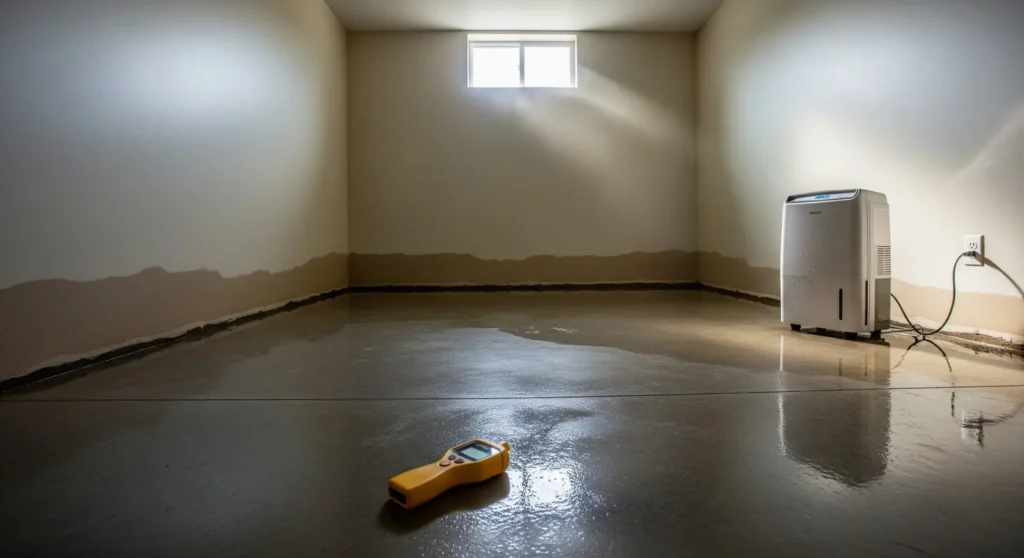
Get a moisture reading, and use the right test for your substrate. Professional flooring restorers use calibrated moisture meters to read the actual moisture content of your subfloor, wood floors, and concrete slabs. For hardwood flooring over a wood subfloor, the National Wood Flooring Association recommends a moisture content differential of no more than 4 percentage points between the subfloor and the flooring being installed. Most kiln-dried hardwood arrives at 6 to 9 percent moisture content, which means a wood subfloor needs to read below 12 percent before reinstallation begins.
Over concrete slabs (the most common substrate in Calgary basements), a standard pin meter reading is not sufficient. Concrete moisture must be tested using a calcium chloride test or an in-situ relative humidity probe per ASTM F2170. These tests measure vapor emission from within the slab, not just the surface. A contractor who reads a concrete slab with a wood-mode pin meter and calls it ready is skipping a critical step. Ask specifically which test they use on concrete.
Skipping moisture testing is the single most common mistake homeowners make after a flood. A floor installed over a subfloor reading 18 to 20 percent moisture will cup, buckle, or develop mold growth within weeks. That is not a warranty claim. It is a second restoration project.
Structural drying. Professional drying involves industrial dehumidifiers, air movers, and sometimes desiccant systems depending on the volume of moisture. A proper drying job typically takes three to five days, with daily moisture readings to track progress. Reinstalling flooring over a wet subfloor to restore your home faster is one of the most costly decisions you can make.
Check for signs of mold. Black staining on the subfloor, a musty smell rising from the floor, or soft spots when you press down are all indicators that mold has already begun to develop. Before disturbing any visibly stained material, put on an N95 respirator and gloves. Lifting moldy materials without protection releases concentrated spore clusters into the air. Calgary’s alluvial soils and relatively humid summer conditions make mold development faster here than in drier climates.
Floorscapes Flooring Team: We tell every homeowner the same thing after a flood: the floor you can see is not the problem. It is the floor you cannot see (the subfloor, the concrete, the framing underneath) that determines whether your restoration project costs $5,000 or $25,000. Get the right test run first. Everything else is just cosmetics.
What Flooring Makes Sense After a Flood? Your Replacement Guide
Once your subfloor is properly dried and cleared, it is time to choose replacement flooring. The flood itself is useful information: it tells you exactly what your home’s moisture exposure risk level is, and that should guide your material choice going forward.

Luxury Vinyl Plank (LVP) is the safest choice for moisture-prone areas. This is particularly true for basements and main-floor spaces in homes with slab foundations or below-grade rooms. COREtec and Torlys both carry excellent waterproof LVP lines that handle Calgary’s seasonal humidity swings without expansion and contraction issues. These products are also easy to lift in sections if a future flood event occurs. Installed cost in Calgary typically runs $5.00 to $10.50 per square foot depending on product grade, subfloor conditions, and removal of existing material.
Engineered hardwood is the better long-term investment for confirmed-dry main-floor spaces where the flood came from a contained source — a burst pipe, an appliance failure — rather than groundwater or sewer backup. Engineered wood uses a real hardwood veneer over a dimensionally stable core, making it significantly more resistant to humidity-driven movement than solid hardwood. It looks and feels like real wood, holds resale value more reliably than LVP, and can be refinished years down the road. Lauzon and Preverco both offer high-quality engineered lines that perform well in Calgary’s climate. Installed cost runs approximately $10.00 to $18.00 per square foot.
Solid hardwood in a previously flooded space requires serious consideration. It is the most beautiful long-term option and refinishable multiple times over its lifespan. But it is also the most sensitive to ongoing moisture exposure. If the flood revealed a moisture entry problem in your home (groundwater, foundation seepage, recurring condensation), installing solid hardwood before resolving that underlying issue is a mistake. Installed cost in Calgary runs $14.00 to $23.00 per square foot.
Tile is the most water-tolerant hard surface option and the correct choice for bathrooms, laundry rooms, and basement utility areas. Daltile and Ceratec offer excellent porcelain options that are impervious to water at the surface. Allow 48 to 72 hours for thinset to cure before grouting — longer in a recently flooded basement where residual slab moisture slows the cure. Tile installation in Calgary runs approximately $9.00 to $18.00 per square foot installed.
|
Flooring Type |
Material (per sq ft) |
Labor (per sq ft) |
Total Installed |
Cargary Notes |
|---|---|---|---|---|
|
Luxury Vinyl Plank |
$3.00–$7.00 |
$2.00–$3.50 |
$5.00–$10.50 |
Safest choice for flood-prone areas, including basements |
|
Engineered Hardwood |
$6.00–$12.00 |
$4.00–$6.00 |
$10.00–$18.00 |
Best long-term value on confirmed-dry main floors |
|
Solid Hardwood |
$9.00–$15.00 |
$5.00–$8.00 |
$14.00–$23.00 |
Only after moisture issue is fully resolved |
|
Porcelain Tile |
$4.00–$10.00 |
$5.00–$8.00 |
$9.00–$18.00 |
Excellent for bathrooms, laundry, lower-level utility |
|
Laminate |
$2.50–$5.00 |
$2.00–$3.50 |
$4.50–$8.50 |
Not recommended for flood-prone areas; susceptible to swelling |
Luxury Vinyl Plank
Material (per sq ft)
$3.00–$7.00
Labor (per sq ft)
$2.00–$3.50
Total Installed
$5.00–$10.50
Calgary Notes
Safest choice for flood-prone areas, including basements
Engineered Hardwood
Material (per sq ft)
$6.00–$12.00
Labor (per sq ft)
$4.00–$6.00
Total Installed
$10.00–$18.00
Calgary Notes
Best long-term value on confirmed-dry main floors
Solid Hardwood
Material (per sq ft)
$9.00–$15.00
Labor (per sq ft)
$5.00–$8.00
Total Installed
$14.00–$23.00
Calgary Notes
Only after moisture issue is fully resolved
Porcelain Tile
Material (per sq ft)
$4.00–$10.00
Labor (per sq ft)
$5.00–$8.00
Total Installed
$9.00–$18.00
Calgary Notes
Excellent for bathrooms, laundry, lower-level utility
Laminate
Material (per sq ft)
$2.50–$5.00
Labor (per sq ft)
$2.00–$3.50
Total Installed
$4.50–$8.50
Calgary Notes
Not recommended for flood-prone areas; susceptible to swelling
Pricing reflects 2026 Alberta market data provided by Floorscapes. Subfloor repair or levelling adds $2.20 to $4.75 per square foot if required.
Want a quote built around your actual space? Visit our showroom this week and we will measure and price your project at no charge.
If you are replacing your flooring after a flood and wondering which hard surfaces hold up best in everyday Calgary life, our guide to water-resistant flooring options after a flood covers durability across traffic levels and room types.
The Long-Term Reality: Living With Your Floors After a Flood
A flood is a one-time event, but what you learn from it should permanently change how you maintain your home’s floors.
Winter maintenance. Calgary winters are dry. When your furnace runs continuously from November through March, indoor humidity can drop well below 25% without you realizing it. The NWFA recommends maintaining indoor humidity between 35 and 55 percent for hardwood floors. Below 30 percent, wood contracts and gaps appear between planks. A whole-home humidifier is not a luxury in Calgary; it is basic floor maintenance infrastructure. Pair it with a simple hygrometer, available at any hardware store for under $20, so you can confirm your actual indoor reading year-round rather than guessing.
Spring prep matters most. In February and March, check your eavestroughs, downspouts, and the grading around your foundation before the chinooks arrive and temperatures swing. Downspouts should discharge at least 1.5 metres from your foundation wall. Snow piled against your foundation walls is essentially a slow-release moisture delivery system aimed directly at your subfloor. Shovel it back and away from the house before the thaw begins.
The musty smell test. If you notice a musty smell rising from your floors, particularly after a wet spring, do not ignore it. Musty odors indicate microbial growth beneath the surface. Catching mold early, before it compromises the subfloor framing, is the difference between a minor remediation and a full structural repair. If you want to investigate, wear an N95 respirator and gloves before disturbing anything. Then lift a baseboard and look at the edge of the flooring and the bottom of the drywall. Staining or discoloration confirms that remediation is needed.
Know when to call a professional. Any soft spot in a floor, any bounce or flex where there was not one before, and any floor that is visibly uneven after a flood event are all signs that the subfloor itself may be compromised. A flooring professional with moisture meters can assess this in a single visit. If you are based anywhere from SE Calgary to Okotoks or Cochrane, we cover your area for flooring assessment and restoration and serve homeowners across the Calgary region.
“We’ve used Floorscapes several times over the last 10 years from full renovations to refinishing our hardwood. Bryce will work with you to ensure you get the flooring you want. Their crews are on time, very professional in their work, and make sure you’re happy with the end result.” — Lana B., Calgary — Hardwood Refinishing and Renovation
How to Choose a Flooring Contractor After Water Damage in Calgary
Not every flooring contractor has experience with post-flood restoration. The difference between a knowledgeable installer and an inexperienced one becomes obvious when a floor installed over a wet subfloor starts cupping two weeks later.
Here is what to ask before you sign anything:
Ask about moisture testing protocol, and which test they use on concrete. A contractor who is not bringing a moisture meter to your subfloor assessment should not be installing your new floors. For wood subfloors, ask what moisture content reading they require before proceeding with hardwood or engineered hardwood installation, and what their process is if the subfloor does not meet that threshold. The correct answer involves rescheduling, not proceeding. For concrete slabs, ask specifically whether they use a calcium chloride test or an in-situ relative humidity probe (ASTM F2170). A pin meter reading on concrete is not a sufficient substitute.
Ask about vapor barriers. On concrete slabs, a proper vapor barrier is non-negotiable before installing any wood-based product. Ask what type they use and why. The answer tells you whether you are dealing with someone who understands moisture management or someone who is just laying floors.
Ask who does the work. Some flooring companies subcontract installation to crews they have not personally trained. At Floorscapes, our installation teams are in-house and have been trained to our standards. After a flood, the last thing you need is a crew with no long-term accountability to your project.
Red flags in a quote. Any quote provided without an in-person site visit should be declined. No one can quote post-flood restoration accurately from photos alone. Also watch for vague warranty language, particularly language that excludes moisture-related issues. After a flood, moisture is exactly the issue you need covered.
Check for relevant experience. Ask specifically about insurance rebuild projects and post-flood flooring restoration. The logistics of working within insurance scope of loss, coordinating with adjusters, and sourcing products that match or improve on the original specification require experience that not every flooring company has. We have been handling restoration and insurance rebuild projects for Calgary homeowners for nearly 30 years.
For homeowners thinking ahead about which flooring to install next, our guide on choosing replacement flooring after water damage covers the full range of options and where each one makes the most sense.
Frequently Asked Questions: Water Damage Floors in Calgary
How much does it cost to replace flooring after a flood in Calgary?
Replacement costs vary significantly by material and the condition of your subfloor. Luxury vinyl plank runs $5.00 to $10.50 per square foot installed. Engineered hardwood runs $10.00 to $18.00 per square foot installed. If the subfloor requires repair or levelling, add $2.20 to $4.75 per square foot for that work. A typical basement or main-floor flood covering 500 to 800 square feet commonly runs between $4,000 and $12,000 for materials, labour, and subfloor prep.
How does Calgary’s soil and groundwater situation affect my floor replacement decision?
Calgary sits on permeable alluvial gravel that allows groundwater to rise rapidly when the Bow or Elbow rivers are high. Groundwater entry is classified as Category 3 contaminated water under the IICRC S500 standard, which means any wood flooring or wood-based subfloor materials it contacts must be removed, not dried. Homes in lower-lying inner-city and older SE Calgary neighborhoods have elevated long-term subfloor moisture risk. Solid hardwood is a higher-risk choice than engineered hardwood or LVP for these homes, regardless of whether a flood has occurred.
How long does the flooring replacement process take after a flood?
The most time-consuming part is drying, not installation. A properly dried subfloor takes three to five days under professional dehumidification, with daily moisture readings to confirm progress. LVP or laminate can be installed in one to two days for a typical room. Engineered hardwood requires 48 hours of acclimation on site before installation. Tile requires 48 to 72 hours of thinset cure time before grout can be applied. From the day water extraction begins to the day you can walk on your finished floor, plan for seven to fourteen days.
How do I know if my subfloor is damaged, not just my floor covering?
Walk the affected area and pay attention to flex, bounce, or softness underfoot. A healthy subfloor has no give. Any area that feels spongy or sounds different when you walk on it has likely absorbed moisture into the wood panels themselves. Visible staining, dark discoloration, or separation between subfloor panels are also indicators. In some Calgary homes, particularly those with OSB subfloors installed in the 1990s and 2000s, a single significant flood event is enough to require full subfloor panel replacement in the affected zone.
Is it a mistake to just dry out my hardwood floor and skip professional assessment?
Yes, in most cases. The most common post-flood mistake Calgary homeowners make is running fans and heat for a week, deciding the floor looks okay, and moving back in. Surface appearance is not a reliable indicator of subfloor moisture. A floor that looks flat and dry can be sitting on a subfloor reading 20 percent moisture content. Any hardwood installed on that substrate will cup and buckle within weeks. And if the flood source was groundwater, no amount of drying saves the wood. Category 3 water exposure means removal. Professional assessment takes an hour and costs very little compared to a second remediation project.

Start Your Restoration with Floorscapes
If your floor flooded, the most important next step is getting the right people to look at it before any decisions are finalized.
We have been serving Calgary homeowners from our showroom at 525 58 Avenue SE since 1996. We have handled restoration projects ranging from single-room repairs to full insurance rebuilds, and we understand Calgary’s specific moisture challenges because we have spent nearly three decades installing floors across every neighborhood in the city.
Call Now: (403) 296-0985
Stop-in any day this week. No appointment needed. Bring your photos, your insurance documents, and your questions. We will walk you through your options clearly, give you an honest assessment of what your subfloor needs before any flooring goes in, and provide a written quote with no guesswork.
Written by Bryce Osborne, owner of Floorscapes. We are members of the National Wood Flooring Association (NWFA) and the Alberta Floor Covering Association (AFCA), and have served over 20,000 Calgary homeowners since 1996.
About the Author: Bryce Osborne is the owner of Floorscapes, a family-owned Calgary flooring company he has led since 1996. With nearly 30 years of hands-on experience across more than 20,000 Calgary homes, Bryce is a certified member of the National Wood Flooring Association (NWFA) and the Alberta Floor Covering Association (AFCA). The guidance in this article follows IICRC S500 water damage remediation standards and reflects our team’s direct experience with post-flood flooring restoration across Calgary.